

Part One of a Two-Part Series
Although most of us have encountered transformers in our professional lives, it’s surprising just how little the average designer or technician knows about them. A transformer’s principal function is to “transform” alternating current from an undesirable voltage to a voltage that is appropriate for the circuit at hand. A good example of this application is the use of control transformers to reduce high line voltages to lower, and safer, control voltages. The lower control voltage can be safely utilized within the control cabinet and throughout the various components that populate the equipment.
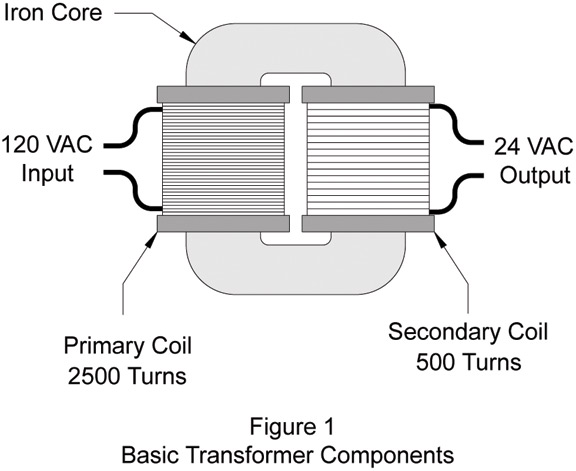 Transformers accomplish this task by inductively coupling the primary and secondary coils. As the voltage rises and falls in the primary coil, it creates a matching magnetic field that induces a sympathetic voltage in the secondary coil. To manipulate the input and output voltages, the number of turns in each coil is adjusted to produce a “ratio” between the primary and secondary coils of the transformer. Thus, if a transformer has 100 turns on the primary and 50 turns on the secondary, then it has a 2 to 1 ratio. Therefore, when 120 VAC is applied to the primary, the secondary will produce 60 VAC. If the roles of the coils are reversed and 120 VAC is applied to the secondary, then the primary will produce 240 VAC. The currents involved go through an inverse transformation during this process, i.e., if the secondary output requires 60 VAC @ 5 Amps, then the primary must be fed 120 VAC at a minimum current of 2.5 Amps. Figure 1 illustrates the turn ratios and voltage/current transformation of a transformer.
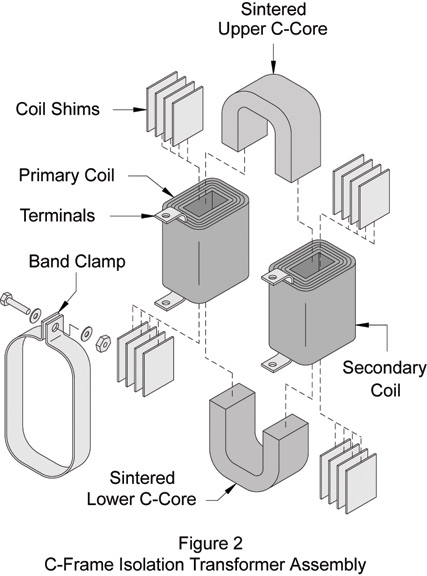
Principally, there are two types of transformers commonly available on the market: isolation and auto. Most transformers are isolation units, where the primary and secondary coils are electrically isolated from one another. An isolation transformer provides two distinct features that are very desirable for most applications. First is that the secondary circuit is electrically isolated from the higher, and more dangerous, input voltage. This provides a level of safety that is essential for most circuits. The second feature is that an isolation transformer will naturally filter high voltage transients and high frequency noise. In a dirty electrical environment this feature can play an important role in protecting delicate electronics. In some cases, an isolation transformer can mean the difference between having a reliable piece of equipment versus a completely nonfunctional piece of junk.
Figure 2 shows an exploded view of a typical “C” core isolation transformer. Note that the two coils are completely separate from one another, both physically and electrically. The only coupling between the two coils is magnetically through the core.
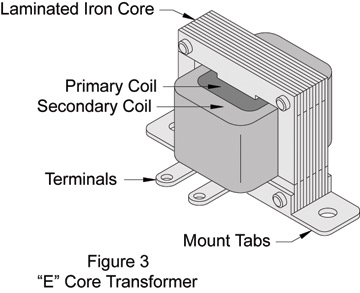
Figure 3 shows a typical “E” core transformer. In this case the primary and secondary coils are placed around a common post in the center of the core. This arrangement produces a more compact unit with higher efficiencies. For these reasons, “E” core designs are the preferred pattern for control and general purpose transformers.
For applications where isolation is not desired, or not necessary, an auto-transformer may be specified. These transformers are commonly used for voltage matching. In cases where a piece of equipment may be configured for a different voltage standard than is available at the install site, a voltage matching auto-transformer provides an economical solution to the problem. A common example is a piece of equipment wired for 240 VAC being placed in a building with 208 VAC service. In this case a fairly modest auto-transformer can boost the service and the problem is quickly solved.
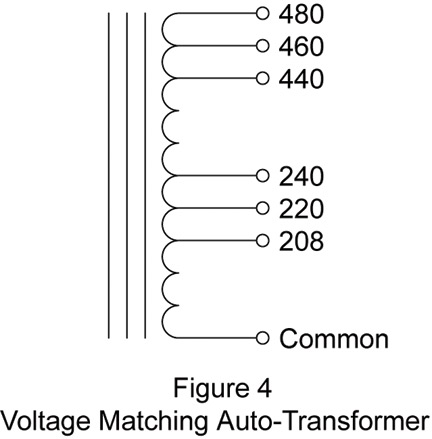
Figure 4 shows a schematic representation of a voltage matching auto-transformer. In this case the line voltage is connected to the appropriate input terminals and the adjusted voltages are available at the various output terminals.
Although there are literally thousands of uses for transformers, the bulk of these applications fall into four basic categories. The most visual application is power distribution through the national grid. One needs only to look up at the telephone poles that have overrun our landscape and you’ll most likely see a pole transformer.

The second category for transformers is power distribution for buildings. In these cases, a high standard voltage from the grid is connected to the building and routed to a central distribution transformer. The outputs of these transformers are designed to provide nearly every standard voltage that exists in the country. Figure 5 shows a schematic representation of a three-phase distribution transformer. Notice that the transformer is an isolation design, which helps protect the building from high voltage transients and noise that may be carried on the grid.
Part Two, to be continued in Issue 16, will include incorporating transformers into a machine element, control applications for transformers, plus more. Read it here: http://library.automationdirect.com/transformers-application-construction-and-efficiencies-issue-16-2010/
By Brian S. Elliott
Originally Published: Sept. 1, 2009